In this tutorial, we will look at the cart pole environment and implement our first agents!
Notebook Cell
import gymnasium as gym
import matplotlib.pyplot as plt
import numpy as np

from matplotlib import animation
from matplotlib.animation import FuncAnimation
from IPython.display import HTML

# set animations to jshtml to render them in browser
# plt.rcParams["animation.html"] = "jshtml"

SEED = 19
rng = np.random.default_rng(SEED)

def new_seed(rng):
    return rng.integers(10_000).item()
Notebook Cell
def replay(frames):
    fig, ax = plt.subplots()
    img = ax.imshow(frames[0])
    ax.axis("off")

    def update(frame):
        img.set_data(frame)
        return [img]

    anim = FuncAnimation(fig, update, frames=frames, interval=30, blit=True)
    plt.close(fig)
    return HTML(anim.to_jshtml())
class Agent:
"""Abstract base class for our cart pole agents."""
def act(self, obs):
raise NotImplementedError()def evaluate_agent(agent: Agent, n_episodes=10, rng=None):
"""Evaluate the agent's average performance over multiple episodes."""
env = gym.make("CartPole-v1", render_mode="rgb_array")
rng = np.random.default_rng(rng)
seed = new_seed(rng)
observation, info = env.reset(seed=seed)
total_reward = 0
for i in range(n_episodes):
terminated = False
truncated = False
while not (terminated or truncated):
action = agent.act(observation)
# apply the selected action to the environment
observation, reward, terminated, truncated, info = env.step(action)
total_reward += reward
seed = new_seed(rng)
env.reset(seed=seed)
env.close()
return total_reward / n_episodesdef play_episode(agent, seed=19):
"""Run one episode and return replay."""
env = gym.make("CartPole-v1", render_mode="rgb_array")
observation, info = env.reset(seed=seed)
frames = []
terminated = False
truncated = False
while not (terminated or truncated):
frames.append(env.render())
action = agent.act(observation)
# apply the selected action to the environment
observation, reward, terminated, truncated, info = env.step(action)
env.close()
return replay(frames)1. A Random Agent
Let’s start by implementing an agent that just randomly selects an action:
class RandomAgent(Agent):
    """Select a random action."""
    def __init__(self, rng=None):
        self.rng = np.random.default_rng(rng)

    def act(self, obs):
        # TODO: randomly select an action
        raise NotImplementedError()
# Solution
class RandomAgent(Agent):
"""Select a random action."""
def __init__(self, rng=None):
self.rng = np.random.default_rng(rng)
def act(self, obs):
return self.rng.choice([0,1])random_agent = RandomAgent(rng=SEED)
evaluate_agent(random_agent, rng=SEED)21.6play_episode(random_agent)Authorization required, but no authorization protocol specified
Loading...
2. A Naive Approach: Using the Pole Angle
class AngularAgent(Agent):
    """Go either left or right depending on the pole angle."""

    def act(self, obs):
        # 2 is the pole angle
        if obs[2] > 0:
            return 1
        else:
            return 0
angular_agent = AngularAgent()
evaluate_agent(angular_agent, rng=19)45.9play_episode(angular_agent)Authorization required, but no authorization protocol specified
Loading...
3. Data-Driven Approach
rewards = []

for i in range(1000):
    r = evaluate_agent(random_agent, n_episodes=1)
    rewards.append(r)
plt.hist(rewards)
plt.title("Total Reward for a Random Agent")
plt.xlabel("total reward");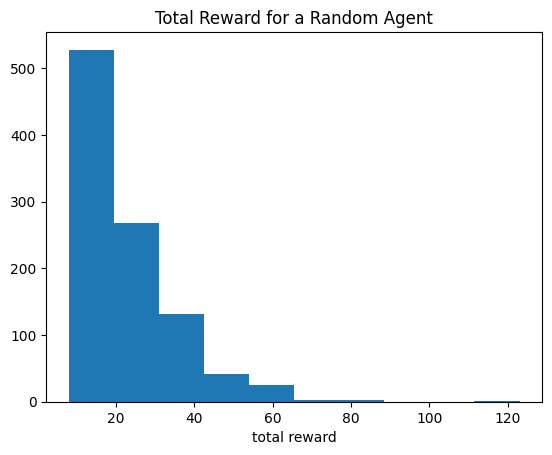
We can see that even with random actions, sometimes the agent survives up to 100 frames! That means that until then, the random agent did not too bad.
Can we use the frames were the agent randomly made the right decisions to somehow train an agent that actually works well?
def generate_train_data(n=100, reward_threshold=50):
    """
    Perform random actions to generate data for n episodes that exceed the reward threshold.
    """
    train_data = []
    data = []

    env = gym.make("CartPole-v1", render_mode="rgb_array")

    observation, info = env.reset(seed=19)
    total_reward = 0

    while len(train_data) < n:
        # select a random action
        action = env.action_space.sample()

        data.append({
            "observation": observation,
            "action": action
        })

        # apply the selected action to the environment
        observation, reward, terminated, truncated, info = env.step(action)

        if terminated or truncated:
            env.reset()
            data = []
            total_reward = 0

        total_reward += reward

        if total_reward >= reward_threshold:
            # save observations and actions as train data
            env.reset()
            train_data.append(data)
            data = []
            total_reward = 0

    return train_data
train_data = generate_train_data()x = np.concat([
np.stack([x["observation"] for x in data]) for data in train_data
])
y = np.concat([
np.array([x["action"] for x in data]) for data in train_data
])from sklearn.tree import DecisionTreeClassifier
model = DecisionTreeClassifier(max_depth=5)
model.fit(x, y)Loading...
from sklearn.tree import plot_tree

fig, ax = plt.subplots(figsize=(20,10))
feature_names = ["cart_position", "cart_velocity", "pole_angle", "pole_angular_velocity"]

plot_tree(model, max_depth=2, feature_names=feature_names, ax=ax);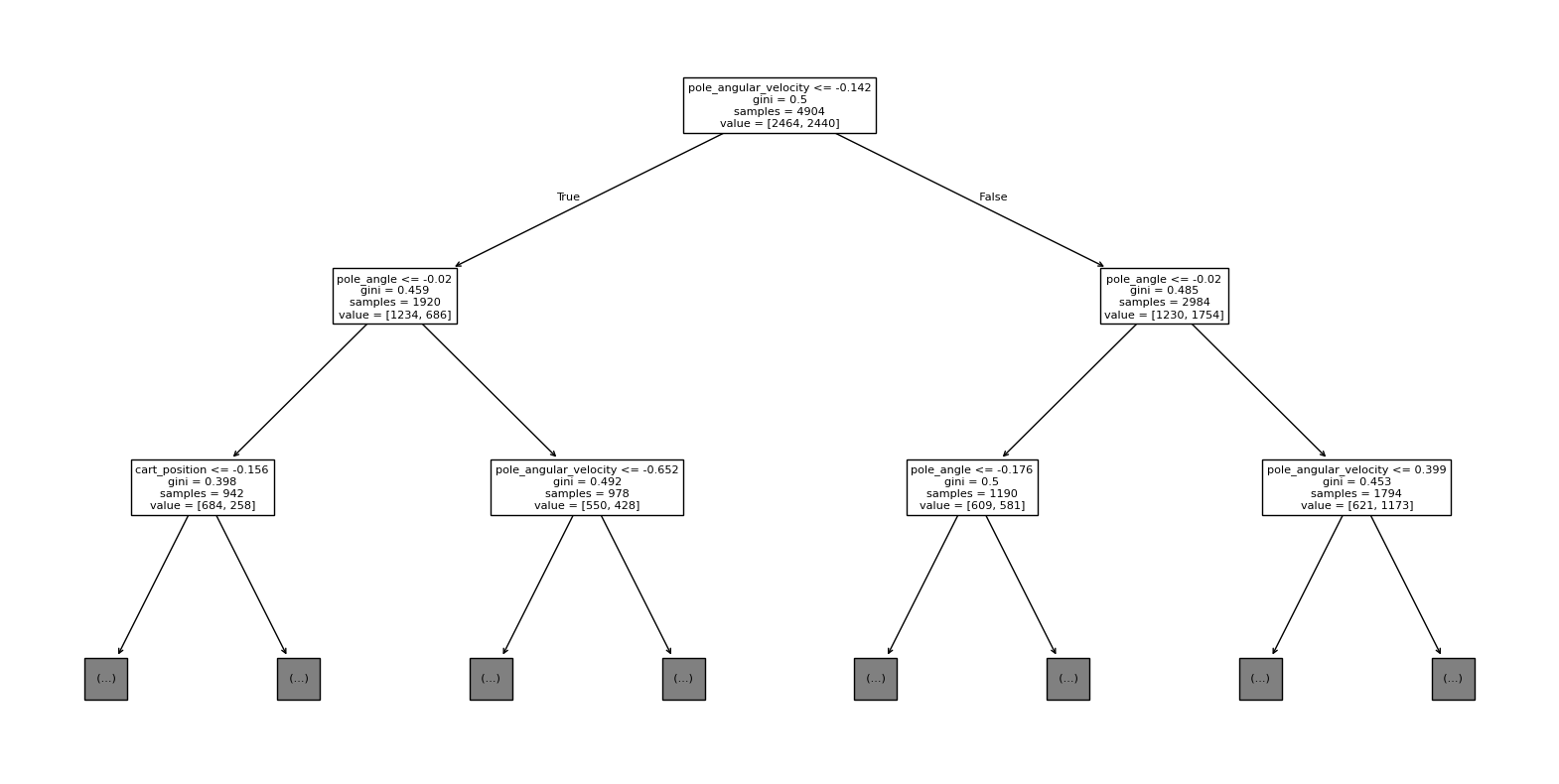
class ModelAgent(Agent):
    def __init__(self, model):
        self.model = model

    def act(self, observation):
        action = self.model.predict(observation.reshape(1,4)).item()
        return action
model_agent = ModelAgent(model)
evaluate_agent(model_agent)338.3play_episode(model_agent)Authorization required, but no authorization protocol specified
Loading...
However, until now, we just tried out simple strategies, that are not actually using Reinforcement Learning.